Book
4 Regression Analysis
In several problems in the medical, biological, industrial, chemical and other areas, it is of great interest to check whether two or more variables are related in some way. To express this relationship it is very important to establish a mathematical model. This type of modeling is called regression, and helps to understand how certain variables influence another variable, that is, it verifies how the behavior of one variable(s) can change the behavior of another.
This relationship can be analyzed as a process. In this process, the values of $X_1, X_2,\ldots,X_n$ are called Input Variables or Regressors (inputs) and $Y$ of Output or Response Variable (output).
Process
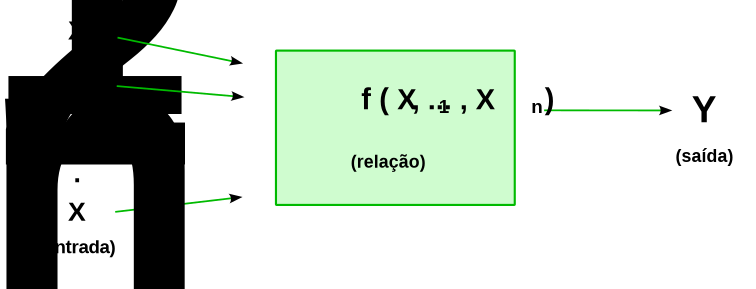
Figure 4.1: Representation of Processes
Regression Analysis makes it possible to find a reasonable relationship between input and output variables, through empirical relationships. The use of this approach requires data collection and the use of statistical methods of Linear Regression Analysis. Data collection makes it possible to understand the nature of the relationship between variables and carry out studies capable of accommodating unexpected situations, such as variability in raw materials, ambient temperature, machines and operators.
If we are interested in the relationship of just one input variable with the response variable we have the case of Simple Linear Regression. But if we want to relate the response variable with more than one regressor variable, the Multiple Linear Regression is used.
If the response variable is a categorical variable, that is, the variable presents as possible achievements a quality (or attribute) and not another measurement, we use the Logistic Regression Model.
Objectives
Regression Models are built with the objectives:
i) Prediction - Since we expect much of the variation in the output variable to be explained by the input variables, we can use the model to obtain values of Y corresponding to values of X that were not among the data. This procedure is called prediction and, in general, we use values of X that are within the range of variation studied. The use of values outside this range is called extrapolation and must be used with great care, as the model adopted may not be correct outside the studied range. Prediction is believed to be the common application of regression models;
ii) Variable selection - Often, we have no idea which variables significantly affect the variation of Y. To answer this type of question, studies are carried out with a large number of variables. Regression analysis can assist in the variable selection process by eliminating those whose contribution is not important;
iii) Parameter estimation- Given a model and a set of data referring to the response and predictor variables, estimating parameters or adjusting a model to data means obtaining values or estimates for the parameters, through some process, based on the model and the observed data;
iv) Inference - The adjustment of a regression model generally has the basic objectives, in addition to estimating the parameters, making inferences about them, such as hypothesis testing and confidence intervals.