Book
5 Basic Statistics
Statistics (or Statistical science) is a set of research techniques and methods that, among other topics, involves planning the experiment to be carried out, qualified data collection, inference, processing, analysis and dissemination of information.
In statistics we work with data, which can be obtained through a sample of the population under study. Next, we define these basic concepts:
Population: set of elements that have at least one characteristic in common. This characteristic must correctly delimit the elements of the population.
Sample: subset of elements of a population, which are representative for studying the characteristic of interest in the population. The selection of the elements that will make up the sample can be done in several ways and will depend on the knowledge you have of the population and the amount of resources available.
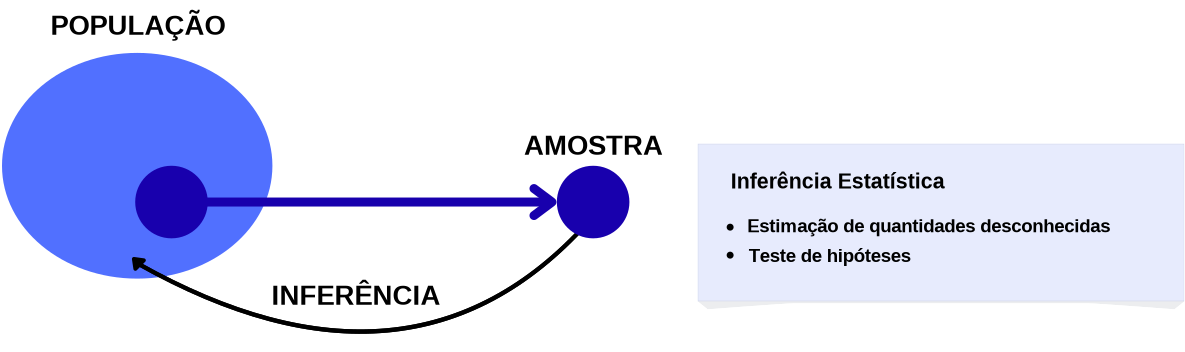
Figure 5.1: Basic statistics
Let’s introduce the basic elements of data analysis. We will see Descriptive Statistics used to organize, summarize and describe important aspects of data behavior. Data description can also identify anomalies, even resulting from the incorrect recording of values and extreme values (those that do not follow the general trend of the rest of the data set). Descriptive tools are different types of graphs and tables, as well as synthesis measures: position measures and dispersion measures.
Whenever we summarize a set of data, we lose information about it, as we condense the original observations. However, this loss of information is small compared to the gain from the clarity of interpretation provided.